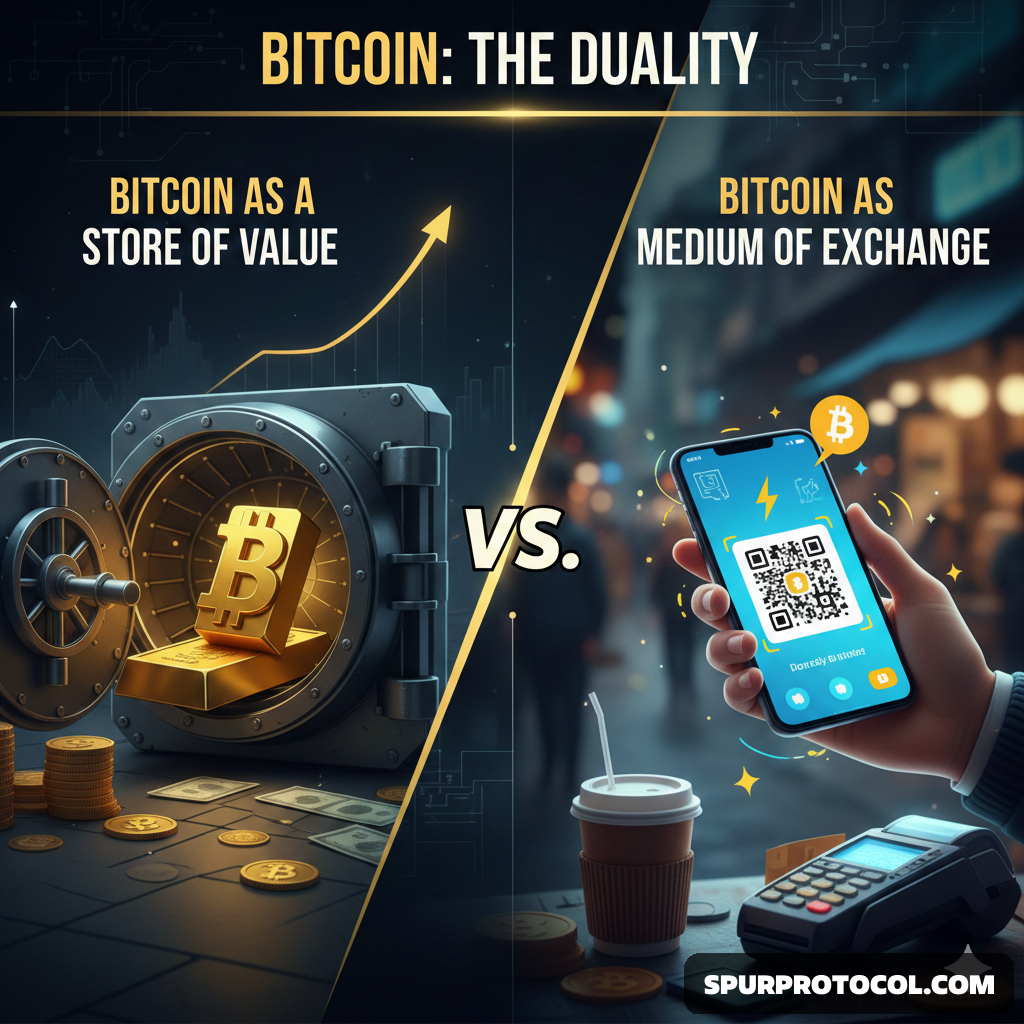
Bitcoin As A Store Of Value Vs. Medium Of Exchange
The debate over Bitcoin as a Store of Value (SoV) versus a Medium of Exchange (MoE) is the central tension in its evolution. While its original whitepaper described it as a "Peer-to-Peer Electronic Cash System," its trajectory has leaned heavily toward "Digital Gold."
As of 2026, here is how these two roles compare and the current state of the technology.
Go Back
🕒 8:29 PM
📅 Jan 01, 2026
✍️ By chyneyz
1. Bitcoin as a Store of Value (SoV)
This is currently Bitcoin's most dominant role. An asset serves as a store of value if it can be saved and retrieved in the future with its purchasing power relatively intact.
The "Digital Gold" Thesis: Like gold, Bitcoin has a finite supply (21 million coins). Its "hardness" comes from its decentralization and the fact that no government can print more of it.
Institutional Adoption: In 2025–2026, institutional participation has hit record highs. Spot ETFs (like BlackRock’s IBIT) and corporate treasuries (like MicroStrategy) treat Bitcoin as a hedge against fiat currency debasement.
The Volatility Trade-off: While Bitcoin's long-term trend has been upward, its short-term volatility remains a hurdle. Critics argue that an asset that can drop 20% in a month is a poor "store" for someone with a short-term horizon.
2. Bitcoin as a Medium of Exchange (MoE)
A medium of exchange must be widely accepted, stable, and efficient for daily transactions. This has historically been Bitcoin's greatest challenge.
Scalability Issues: The base Bitcoin network can only process about 7 transactions per second (TPS), compared to Visa’s thousands. High on-chain fees during busy periods make buying coffee with "base layer" Bitcoin impractical.
The Lightning Network Solution: To solve this, developers use "Layer 2" solutions. The Lightning Network allows for instant, near-free transactions off the main blockchain. By early 2026, capacity has reached all-time highs, with major exchanges and companies like Block (Square) integrating it into point-of-sale systems.
Psychological Barrier (Gresham’s Law): "Bad money drives out good." People are often reluctant to spend an asset they believe will double in value next year (the "Pizza Day" regret), preferring to spend "depreciating" fiat currency instead.
The "Synthetic" Future
Interestingly, 2026 has seen a rise in Bitcoin-backed stablecoins. These allow users to keep the "value" of Bitcoin as a backstop while spending a stable digital token for daily use. This bridge may eventually resolve the conflict between holding for the long term and spending for