Blockchain In Gaming – Can It Truly Enable Decentralized Virtual Worlds?
The video game industry continues to evolve with new technologies. Blockchain has recently emerged as a tool that promises decentralization and real digital ownership. The key question is whether it can truly support fully decentralized gaming worlds.
Go Back
🕒 3:00 PM
📅 Feb 22, 2026
✍️ By Goko7
Digital Ownership and Player Autonomy
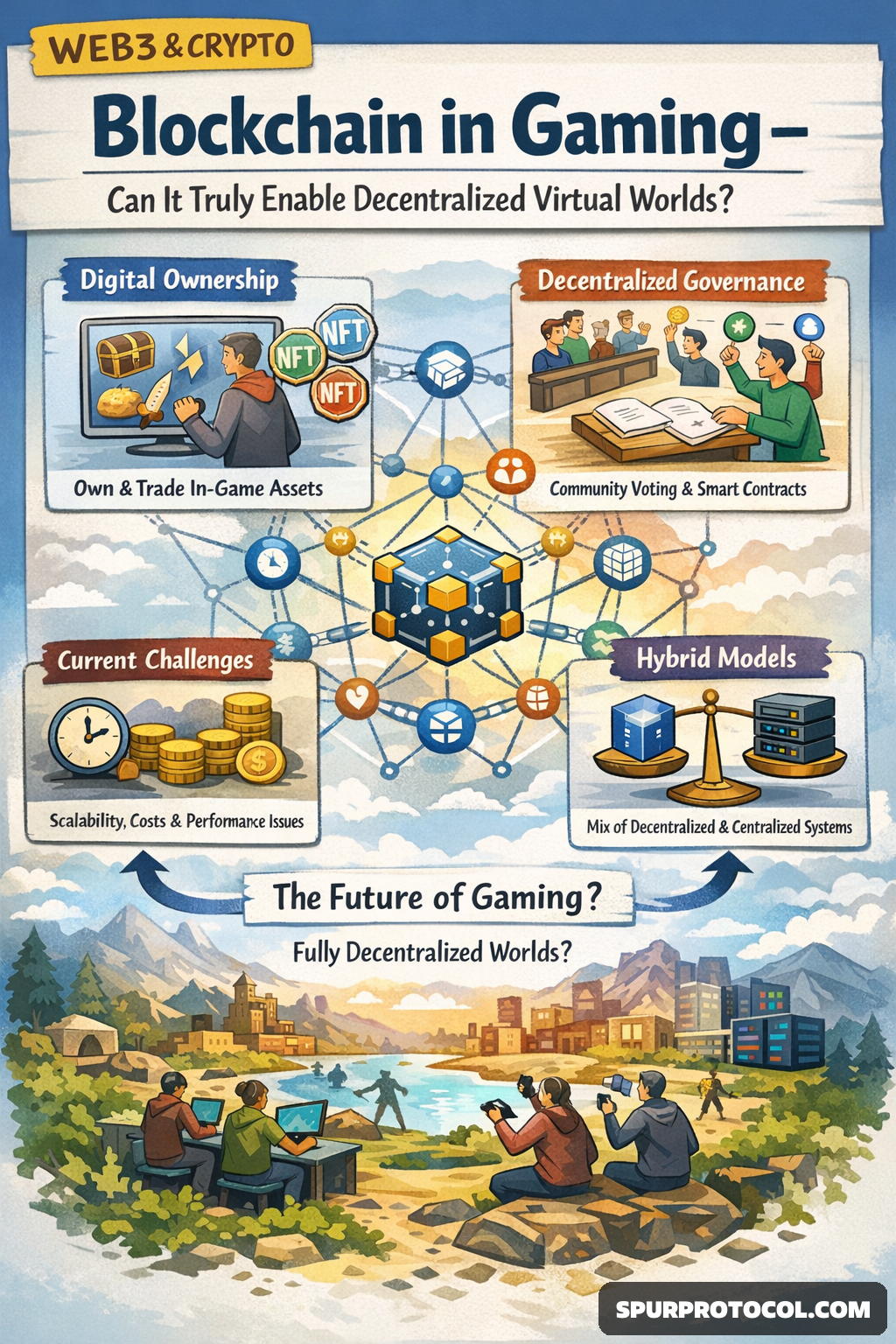
One of the most discussed advantages of blockchain in gaming is the concept of true digital ownership. In traditional gaming ecosystems, in-game assets—such as cosmetic skins, weapons, or characters—are ultimately controlled by the game publisher.
Although players may invest substantial amounts of money in these items, their ownership is limited to the boundaries of the platform.
Blockchain technology introduces a different framework. By recording assets as tokens on a decentralized network, it allows players to hold verifiable ownership of their virtual items. In principle, these assets can be transferred, traded, or sold independently of centralized game servers.
This approach encourages the development of player-driven economies where transactions are transparent and ownership is not merely symbolic, but technically secured.
Decentralized Economies and Community Participation
Beyond ownership, blockchain also opens the possibility for more participatory governance models within games. Through token-based systems, players may be given the opportunity to vote on proposed updates, gameplay adjustments, or economic changes.
This redistributes a portion of decision-making authority from developers to the gaming community.
Smart contracts further enhance this structure by automating transactions and revenue distribution. Marketplaces can operate with greater
transparency, and royalty mechanisms can be embedded directly into the system. As a result, in-game economies may function with reduced reliance on intermediaries, enabling broader global participation.
Practical Limitations and Structural Challenges
Despite its potential, the implementation of fully decentralized gaming environments presents significant challenges. Issues such as network scalability, transaction fees, and latency can directly impact gameplay quality.
Real-time gaming demands high performance and low response times—requirements that many current blockchain infrastructures struggle to meet.
Moreover, decentralization must be balanced carefully with game integrity.
Excessive autonomy or poorly designed economic systems may undermine fairness, stability, or competitive balance. For this reason, many blockchain-based games continue to rely on centralized components to maintain performance and user experience.
Toward a Hybrid Model
Rather than replacing traditional systems entirely, blockchain is more likely to complement existing gaming infrastructure. Hybrid models—combining decentralized asset ownership with centralized performance architecture—are already emerging as a practical solution.
While the vision of entirely decentralized gaming worlds remains ambitious, blockchain is undeniably influencing how players perceive value and ownership within digital environments. If technological constraints are addressed effectively, it may contribute to the development of more transparent, community-oriented, and economically open gaming ecosystems.