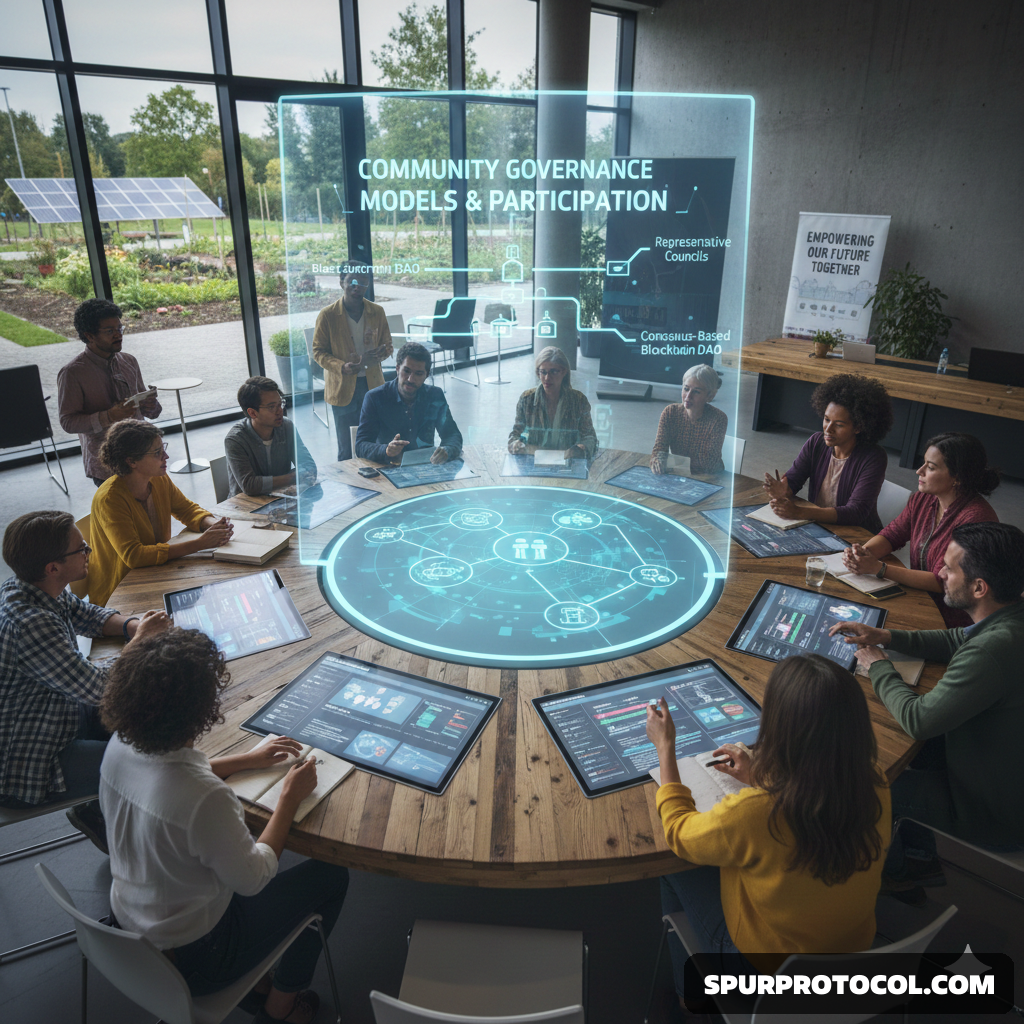
Governance structures are often categorized by who holds power and how decisions are made:
Bottom-Up (Grassroots): Emphasizes local initiative and knowledge. Decisions are often made through consensus or direct democratic voting. Examples include community gardens and informal neighborhood groups.
Top-Down: Often led by municipal or state authorities to provide land security and policy integration, but risks marginalizing local voices if not managed inclusively.
Hybrid (Collaborative/Network): Combines local innovation with institutional support. This model often involves "1 + 1 + N" operations: government centers, social workers, and multi-party coordination.
Specific Typologies:
Common-Pool Resource (CPR)
Management: Focuses on governing shared resources like water or forests based on locally adapted rules (e.g., Elinor Ostrom's design principles).
Community Land Trusts (CLTs): Non-profits that hold land for collective community benefit, often for affordable housing.
Cooperative Governance: Member-owned enterprises that prioritize community needs over profit-maximization.
Levels of Community Participation
Participation is a continuum, ranging from passive involvement to full empowerment:
Inform/Convey: Citizens receive information but have no active role in decision-making.
Consult: Communities are asked for feedback on existing plans or policies.
Involve/Contribute: Members discuss and influence issues, though final authority may remain external.
Collaborate/Co-create: Communities and authorities work together as partners to design solutions.
Empower/Champion: Power and responsibility for decision-making are fully shared or devolved to the community.
Tools and Strategies for Participation
Modern community governance increasingly uses structured tools to ensure engagement:
Participatory Budgeting: Allowing residents to directly decide how a portion of a public budget is spent.
Digital Platforms: Using websites or social media for broader, transparent engagement and accountability.
Grid Management: Dividing communities into smaller "micro-grids" to make service delivery and resident interaction more specific and responsive.
Point Redemption Systems:
Incentivizing participation in activities like environmental protection or volunteering through rewards.
Challenges to Effective Governance
Power Asymmetries: Pre-existing social inequalities (class, gender, ethnicity) can exclude marginalized groups even in "participatory" models.
Participation Fatigue: Low engagement often stems from time constraints, lack of awareness, or distrust of authorities.
Institutional Inertia: Traditional government structures may resist devolving real power to community levels.