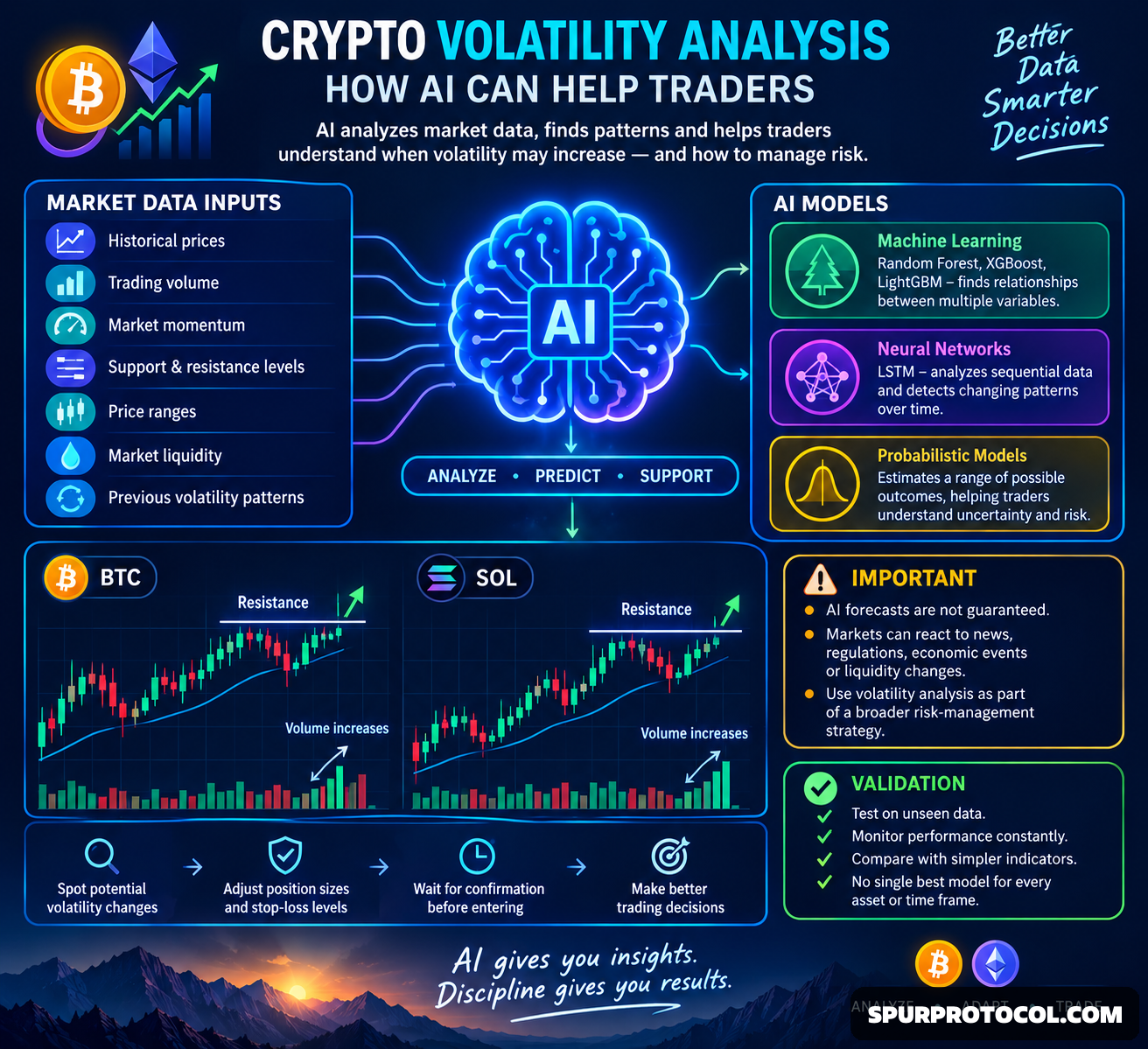
What Is Volatility?
Volatility describes how quickly and how strongly the price of a cryptocurrency moves over a certain period.
For example, if Bitcoin moves from $80,000 to $84,000 in a short period, the market is showing relatively high volatility. High volatility can create profitable trading opportunities, but it also means that losses can increase just as quickly.
For traders, understanding volatility is essential because it helps answer an important question:
Is the market preparing for a strong move, or is it simply moving sideways?
How AI Analyzes Crypto Volatility
Artificial intelligence can process large amounts of market data much faster than a human trader.
AI models can analyze:
Historical price movements
Trading volume
Market momentum
Support and resistance levels
Price ranges
Market liquidity
Previous volatility patterns
By combining these factors, AI can estimate whether volatility is likely to increase or decrease.
For example, if Bitcoin is trading in a narrow range while trading volume starts increasing, an AI model may identify a higher probability of a significant price movement.
However, this does not mean that AI knows whether the next move will be up or down.
AI Models Used in Crypto Trading
Different AI technologies can be used to analyze market behavior.
Machine Learning
Models such as Random Forest, XGBoost, and LightGBM can analyze relationships between multiple market variables and identify patterns that may be difficult to detect manually.
Neural Networks
LSTM networks are particularly useful for sequential data. They can analyze how volatility has changed over time and identify recurring patterns.
Probabilistic Models
Instead of predicting one exact outcome, these models can estimate a range of possible outcomes. This can help traders understand both potential volatility and uncertainty.
From Prediction to Trading Decisions
An AI forecast should never be treated as a guaranteed prediction.
Crypto markets can react unexpectedly to:
Major news
Regulation
Economic announcements
Bitcoin movements
Large whale transactions
Sudden changes in liquidity
Instead of asking, "What will the AI predict?", a better question is:
"How can this information help me manage my risk?"
If an AI model indicates that volatility is increasing, a trader might reduce position size, move or review stop-loss levels, or wait for confirmation before entering a trade.
Example: Bitcoin and SOL
Imagine Bitcoin is approaching a major resistance level while trading volume is increasing.
At the same time, SOL is approaching its own resistance level and beginning to show stronger buying pressure.
This combination could indicate that a breakout is becoming possible.
But a trader should still wait for confirmation.
A genuine breakout would normally be stronger if it occurs with increased volume and the price remains above the resistance level instead of immediately falling back below it.
This is where volatility analysis becomes useful: it helps identify when the market may be preparing for a larger move.
Why Validation Matters
An AI model can perform extremely well on historical data and still fail in real-time trading.
Market conditions constantly change. Liquidity, investor behavior and volatility regimes can all change.
That is why reliable AI systems should be tested using data they have never seen before.
Traders should also compare AI predictions with simpler indicators and continuously monitor whether the model is actually improving decision-making.
The Bigger Picture
AI is a powerful analytical tool, but it is not a crystal ball.
The strongest approach is to combine:
AI analysis + price action + volume + market structure + risk management.
When several independent signals point in the same direction, the trading setup can become more interesting.
But even the best-looking setup can fail.
The goal is therefore not to predict every market move.
The goal is to identify high-probability situations, control risk, and make disciplined decisions.