DAOs 2.0 – Practical Governance With Less Manipulation?
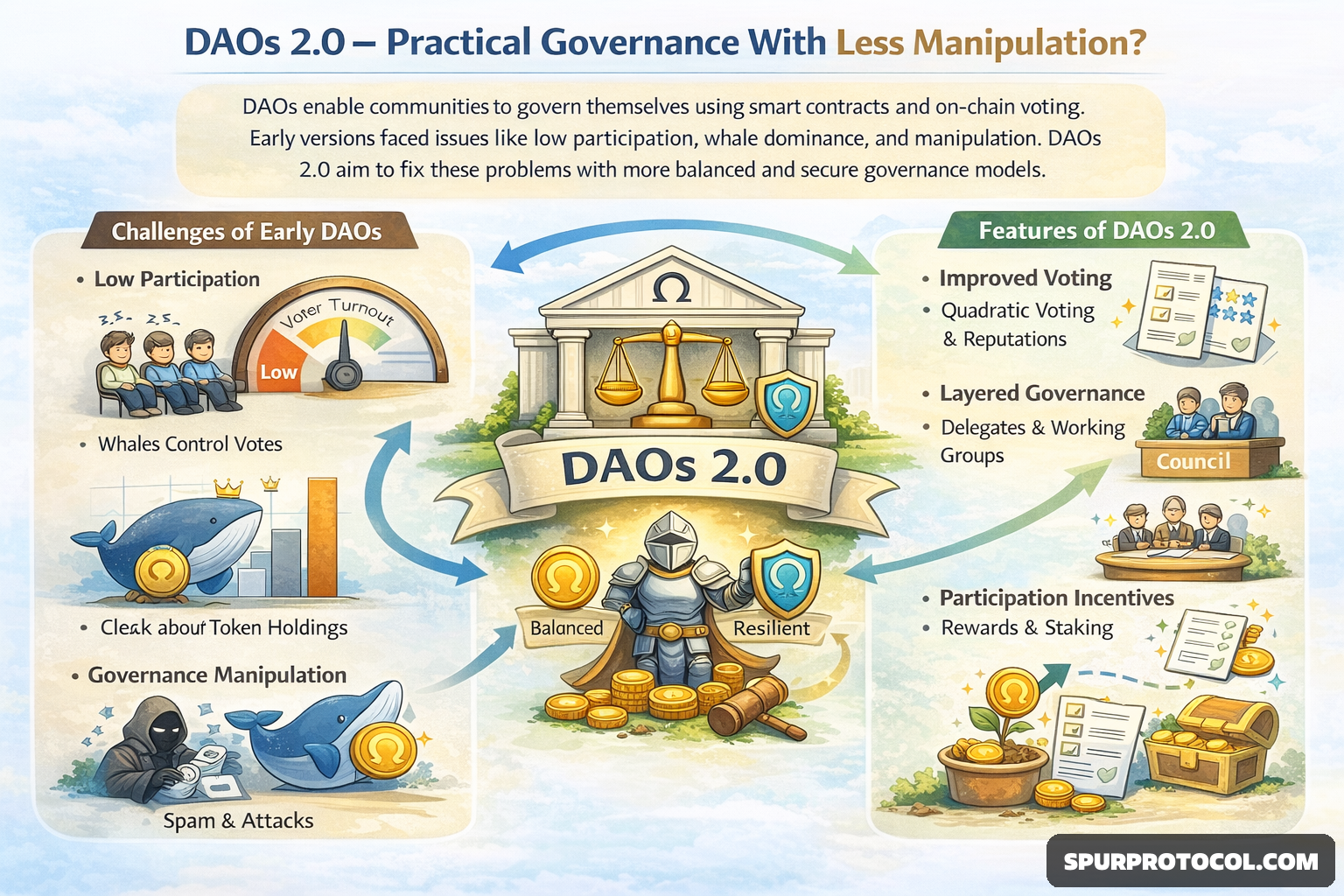
DAOs enable communities to govern themselves using smart contracts and on-chain voting. Early versions faced issues like low participation, whale dominance, and manipulation. DAOs 2.0 aim to fix these problems with more balanced and secure governance models.
Go Back
🕒 8:17 PM
📅 Mar 02, 2026
✍️ By Goko7
Lessons Learned From Early DAO Models
The first generation of DAOs relied mainly on token-based voting, where influence was determined by the number of tokens a person owned. Although this approach was straightforward and easy to deploy, it often led to an imbalance of power. Large holders, often called “whales,” could significantly influence or even control governance outcomes.
Another common issue was low participation.
Many token holders did not actively vote or engage in governance, which meant that important decisions were sometimes made by only a small fraction of the community.
In addition, governance systems were exposed to various forms of abuse, including spam proposals, coordinated voting, and manipulation attempts. These weaknesses showed that simple token-weighted voting alone was not enough to guarantee fair and reliable governance.
Key Improvements Introduced by DAOs 2.0
DAOs 2.0 focus on making governance more balanced, secure, and resistant to manipulation by introducing more advanced participation models.
Some of the most important improvements include:
Quadratic voting, which makes additional voting power progressively more expensive, reducing the dominance of large holders
Reputation-based governance, where influence reflects a participant’s contributions and involvement, not just their capital
Delegated voting, allowing members to assign their voting rights to trusted individuals with more knowledge or expertise
These mechanisms help distribute influence more fairly while still recognizing active contributors.
Many DAOs also implement multi-layer governance structures, where smaller teams or councils manage routine decisions, while the broader community focuses on major proposals. This structure increases efficiency while maintaining decentralization.
Strengthening Participation and Transparency
Encouraging active and meaningful participation is a major priority for modern DAOs.
To support this, some protocols:
Offer rewards to users who participate in governance
Require users to lock or stake tokens before submitting proposals, reducing low-quality submissions
Use filtering and review stages before proposals reach a full vote
Transparency tools, such as governance dashboards, allow members to monitor voting activity, treasury usage, and proposal outcomes. This improves trust and accountability across the organization.
Many DAOs also combine off-chain discussions with on-chain execution, allowing faster coordination while ensuring that final decisions remain transparent and verifiable.
Moving Toward More Practical Decentralization
DAOs 2.0 represent a refinement of the original DAO concept rather than a complete replacement. By addressing earlier limitations, these systems aim to create governance models that are both decentralized and operationally effective.
Although no system can completely eliminate manipulation risks, ongoing innovation in governance design is making DAOs more stable and reliable.
As these improvements continue to evolve, DAOs 2.0 are becoming a stronger foundation for decentralized coordination and long-term digital collaboration.