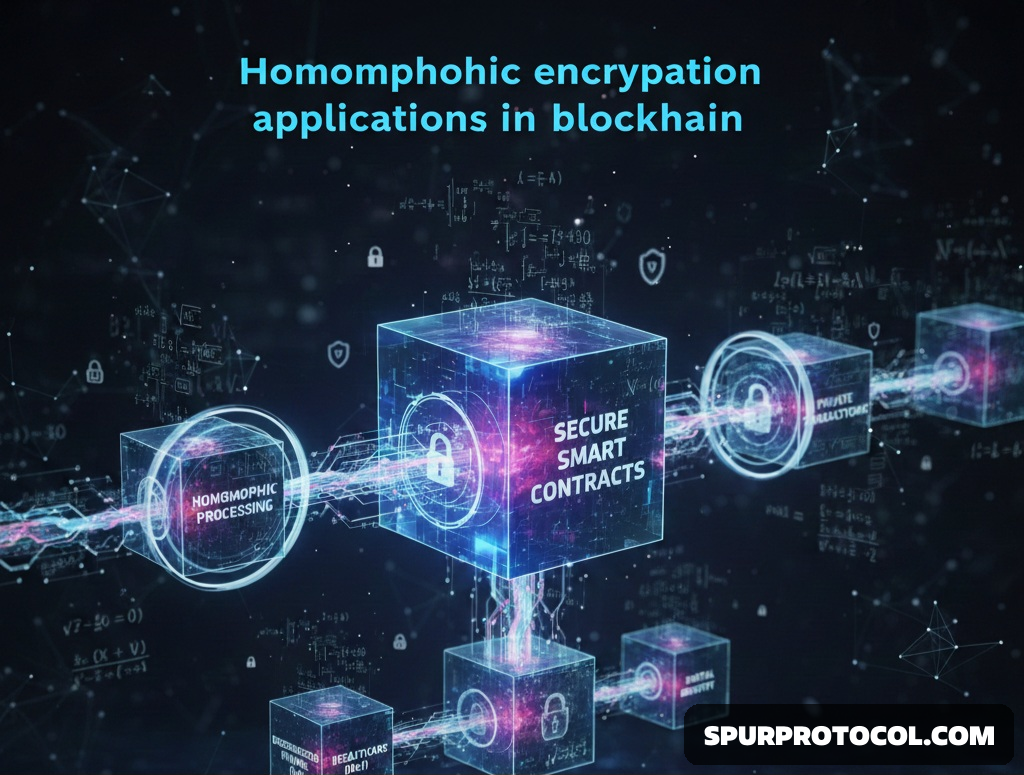
Private Smart Contracts: Executes complex logic (like voting, auctions, or financial agreements) on encrypted data, keeping transaction details confidential while verifying conditions, as seen in frameworks like SmartFHE or platforms like Phoenix.
Confidential Transactions: Enables private financial transactions where only the validity is confirmed on-chain, not the amounts or parties, enhancing privacy in DeFi.
Secure Data Analytics: Allows businesses to run analytics (e.g., machine learning, statistical analysis) on sensitive datasets (like medical records or census data) stored on or processed via blockchain without revealing underlying data.
Decentralized Identity (DID): Users can prove attributes (e.g., age, credentials) without revealing personal data, enhancing privacy in identity verification systems.
Supply Chain Privacy: Securely sharing sensitive data (like trade secrets or quality metrics) across a supply chain on a blockchain, ensuring confidentiality while maintaining transparency.
How it Works (Simplified):
Encrypt: A user encrypts sensitive data (e.g., financial data, medical records) using HE.
Compute on Ciphertext: The encrypted data is sent to the blockchain or a node, which performs computations (addition, multiplication) directly on the ciphertext.
Encrypted Result: The result is an encrypted output.
Decrypt: Only the original user with the private key can decrypt the result, which matches what they'd get from operating on the original unencrypted data.
Benefits:
Enhanced Privacy: Confidentiality for data "in use," not just at rest or in transit, solving blockchain's inherent transparency issue.
Secure Collaboration: Facilitates joint data analysis between competing entities without data sharing.
New Business Models: Unlocks use cases previously impossible due to privacy concerns.
Challenges:
Performance Overhead: Computations on encrypted data are computationally intensive, impacting speed and efficiency.
Integration Complexity: Requires specialized libraries and careful design for blockchain systems.