How OlympusDAO Works
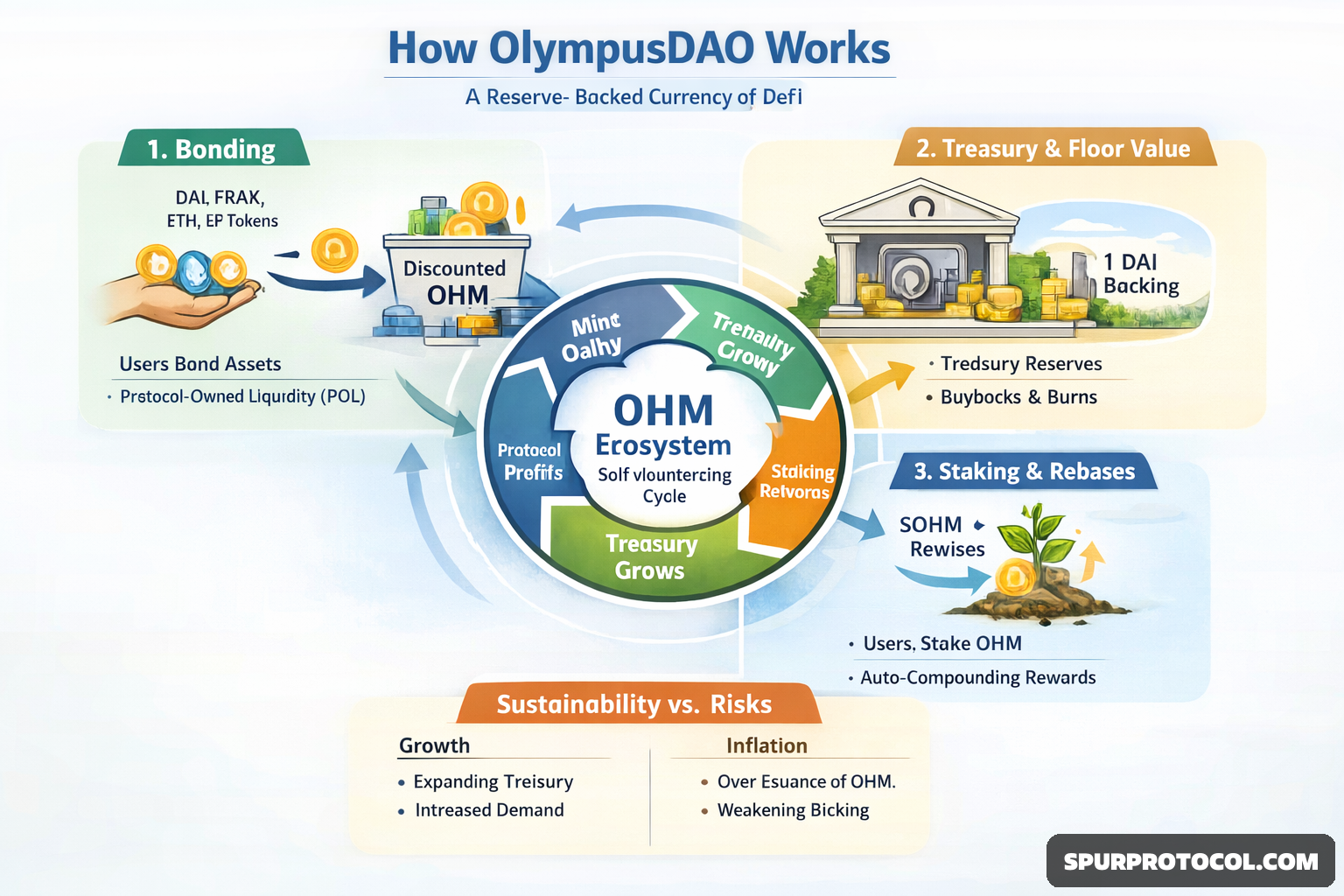
OlympusDAO is a decentralized protocol designed to create OHM — a reserve-backed, free-floating currency in DeFi. Unlike stablecoins, OHM is not pegged to the US dollar but is supported by real assets held in the protocol’s treasury.
Go Back
🕒 8:08 PM
📅 Mar 02, 2026
✍️ By Goko7
1. Bonding: Protocol-Owned Liquidity (POL)
What it is:
Users deposit assets such as DAI, FRAX, ETH, or LP tokens into OlympusDAO and receive newly minted OHM at a discounted price. These OHM tokens are released gradually over a vesting period, typically around 5 days.
Why it matters:
Bonding allows Olympus to accumulate real assets and own its liquidity instead of relying on external liquidity providers. This gives the protocol stronger control, improved stability, and long-term sustainability.
How it works technically:
Bond pricing is determined by the protocol’s debt ratio and a parameter called the Bond Control Variable (BCV). When demand is high, discounts decrease. When demand is low, discounts increase to attract participants.
2. Treasury Backing and Floor Value
Each OHM token is backed by real assets stored in the treasury, with a minimum backing value equivalent to at least 1 DAI. This backing is referred to as the risk-free value (RFV).
If the market price of OHM drops below this backing level, the protocol can buy back OHM from the market and burn it, reducing supply and helping stabilize the price above the floor.
3. Staking: sOHM and Rebases
When users stake OHM, they receive sOHM at a 1:1 ratio. The staking contract automatically performs rebases approximately every 8 hours, increasing the amount of sOHM held.
This means:
Your token balance grows automatically over time
Rewards compound without manual action
No need to claim or restake rewards
Gas fees are minimized
These staking rewards come from protocol revenue, primarily generated through bond premiums and liquidity fees.
How the System Works as a Whole
OlympusDAO operates as a self-reinforcing economic cycle:
Users bond assets → the treasury grows → new OHM is minted.
The treasury generates revenue from bond premiums and liquidity fees.
Stakers lock OHM and receive rewards through rebases, reducing circulating supply.
The protocol retains a portion of newly minted
OHM as profit and reserves.
High yields attract more bonding and staking, strengthening the treasury further.
This creates a closed-loop system where liquidity is owned by the protocol, supply is backed by real assets, and participants are incentivized to support long-term growth.
Risks and Sustainability
OlympusDAO’s high yields rely on continuous minting of new OHM, which introduces inflation.
If treasury growth does not keep pace with token issuance, the backing per OHM can weaken, reducing its intrinsic support.
Long-term sustainability depends on:
Continuous treasury expansion
Ongoing demand for bonding and staking
Careful management of token issuance
Some critics argue that extremely high yields may be difficult to sustain indefinitely, especially during market downturns.