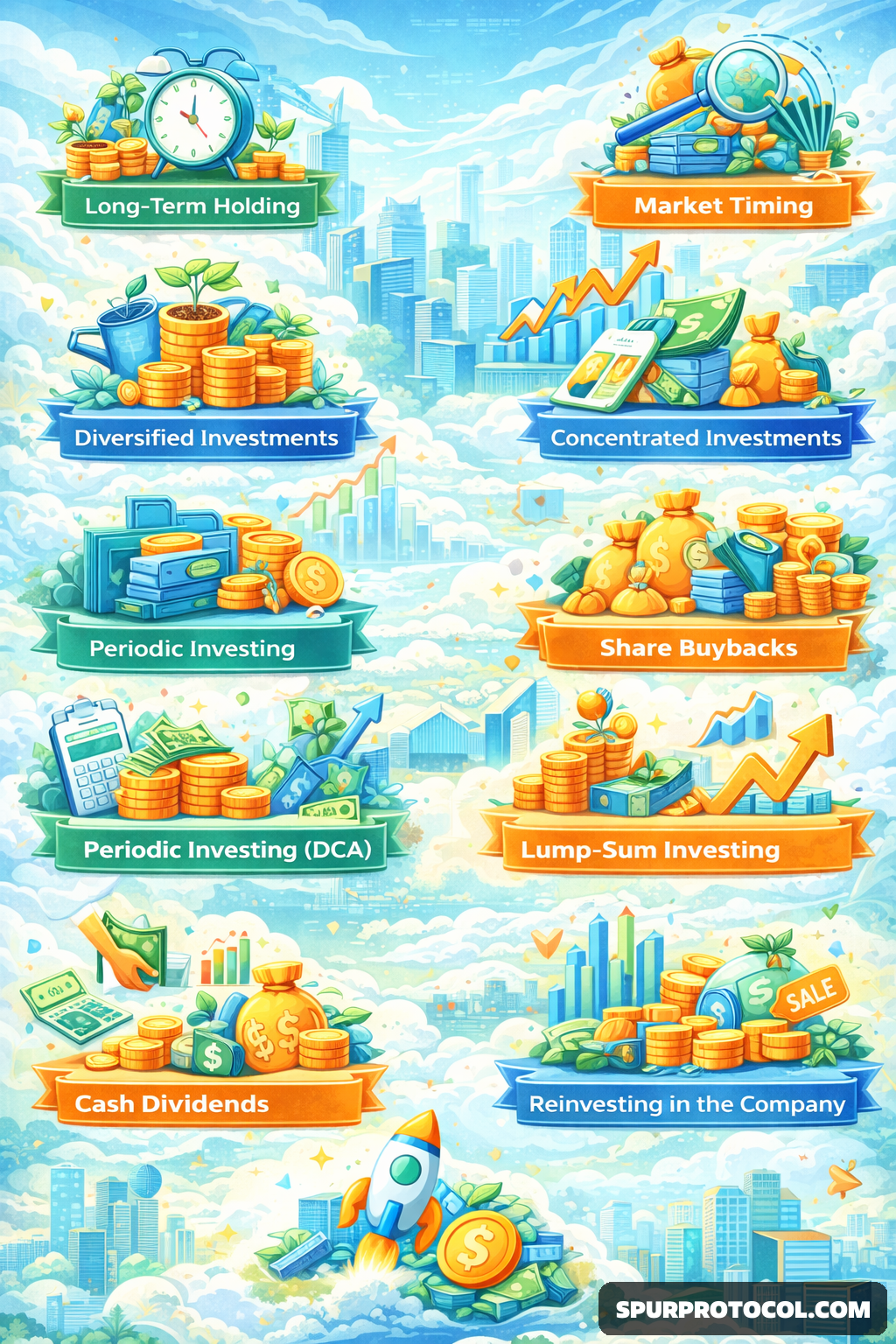
1. Long-Term Holding VS Short-Term Tradin
Long-term holding: Owning quality companies for years or decades, focusing on growth over time rather than daily price swings.
Advantages: Benefit from compounding, lower trading costs, minimal monitoring needed (ideal for employees).
Disadvantages: Funds are tied up, and results accumulate slowly.
Short-term trading: Frequently buying and selling to capitalize on short-term price movements.
Advantages: Rapid capital turnover and high potential gains if timing is right.
Disadvantages: High fees, time-intensive, psychologically demanding, and risky.
2. Diversified Investments VS Concentrated Investments
Diversified investments: Holding a variety of assets to align with the market’s average return.
Advantages: Reduces risk, suitable for most investors.
Disadvantages: Hard to consistently outperform the market.
Concentrated investments: Investing heavily in a few select assets to aim for higher returns.
Advantages: High potential gains if you have better knowledge or insights than others.
Disadvantages: High risk; effectively gambling if your information is incomplete.
3. Timing the Market VS Long-Term Holding
Market timing: Trying to predict the best moments to buy or sell.
Risk: Missing the market’s strongest days can significantly reduce long-term returns.
Long-term holding: Ignoring short-term fluctuations and maintaining your investment.
Caution: Periods of “dead money” can occur in overheated markets; blind holding is not always optimal.
4. Free Cash Flow VS Share Buybacks
Free cash flow: The actual cash generated by a company after capital expenses.
Insight: Profit is an opinion; cash is reality. Over time, stock prices follow free cash flow.
Share buybacks: The company repurchases its own shares to increase earnings per share.
Caution: Buying back at high valuations can destroy shareholder value; at low valuations, it can enhance it.
5. Cash Dividends VS Reinvesting in the Company
Cash dividends: Directly distributing cash to shareholders.
Advantages: Signals financial strength.
Caution: Very high dividend yields may hide underlying problems.
Reinvesting: Company uses profits to grow operations.
Advantages: Can increase long-term shareholder value if reinvestment is effective.
6. Periodic Investing (DCA) VS Lump-Sum Investing
Periodic investing (Dollar-Cost Averaging – DCA): Investing fixed amounts at regular intervals.
Psychological benefit: Reduces stress and regret, great for employees with consistent income.
Mathematical note: Slightly less efficient than lump-sum investing due to uninvested cash.
Lump-sum investing: Investing all available funds at once.
Advantage: Often mathematically more efficient long-term.
Disadvantage: Can feel psychologically risky for beginners.
7. Growth Stocks VS Value Stocks
Growth stocks: Companies with fast growth, high P/E ratios, and usually no dividends.
Interest rate sensitivity: Rising rates can sharply reduce long-term valuation and put pressure on prices.
Value stocks: Companies with low P/E ratios, stable cash flow, and moderate growth.
Caution: Watch for “value traps”—stocks that appear cheap but face permanent industry decline.