Regulatory Challenges For Web3: How Governments Are Likely To Respond
Web3 is often described as the next evolution of the internet—one where users own their data, control their digital assets, and interact without relying on centralized platforms. While this shift opens the door to new economic models and greater digital autonomy, it also raises complex legal and regulatory questions. Governments worldwide are now working to determine how Web3 fits within existing legal frameworks—and where new rules are necessary.
Go Back
🕒 8:56 AM
📅 Feb 16, 2026
✍️ By Goko7
Why Web3 Is Difficult to Regulate
One of the defining features of Web3 is decentralization. Unlike traditional platforms operated by a single company, many Web3 applications run on distributed networks with no central authority.
This creates a fundamental challenge for regulators, who typically rely on clearly identifiable entities to enforce compliance.
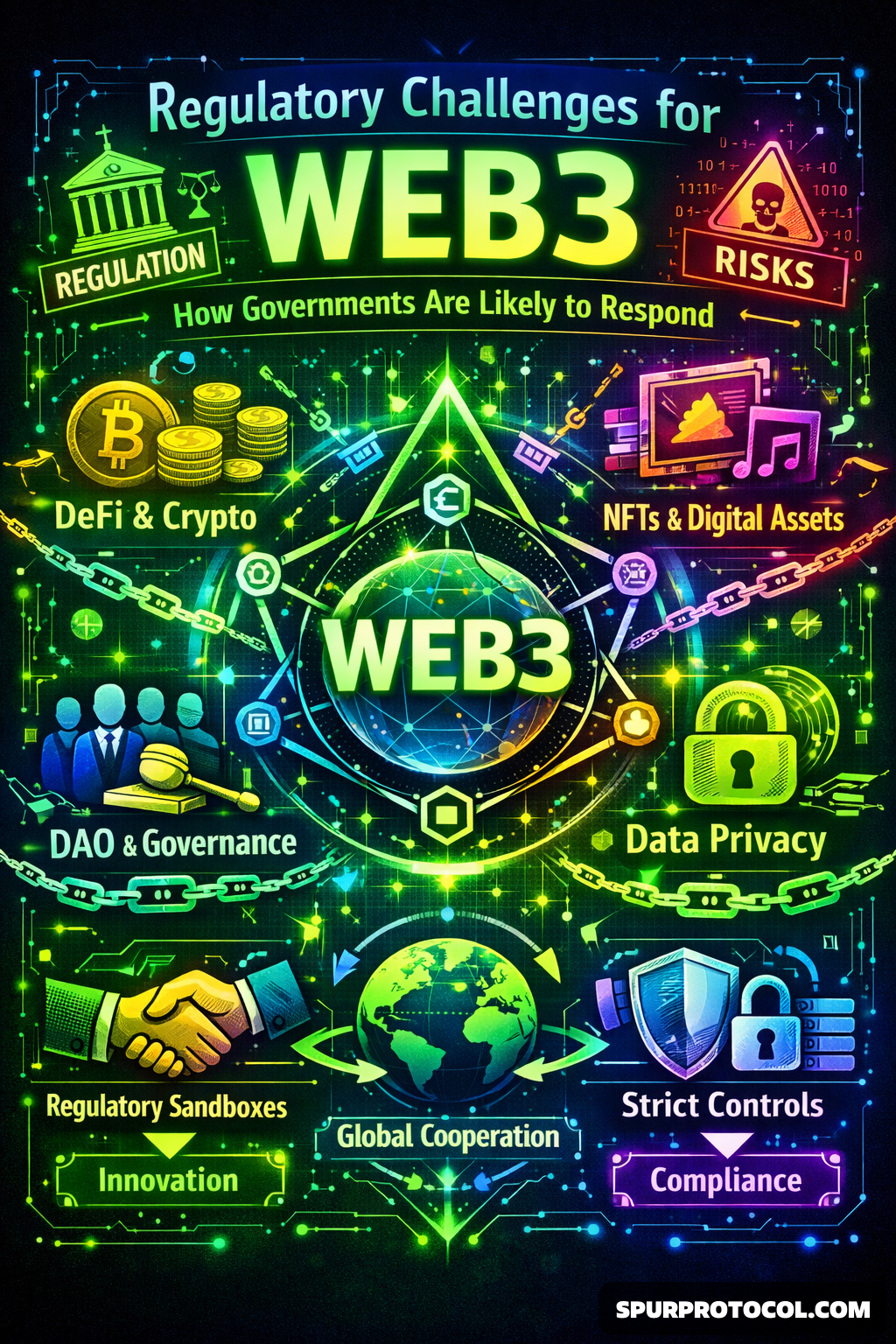
Decentralized finance (DeFi), tokenized assets, and blockchain-based governance systems often perform functions similar to banks, exchanges, or investment platforms—but without the same legal structure. As a result, regulators face uncertainty when trying to classify these services and determine which laws apply.
There are also concerns related to consumer protection, fraud, money laundering, and tax enforcement. Because blockchain transactions can be pseudonymous, identifying bad actors or tracing illicit activity can be more complicated than in traditional financial systems. At the same time, innovation in Web3 is moving faster than most regulatory processes, creating a gap between technological capabilities and legal clarity.
How Governments Are Beginning to Respond
Most governments are not attempting to ban Web3 outright. Instead, their focus is shifting toward creating clearer rules that allow innovation while reducing risks.
In regions like the European Union, policymakers are introducing comprehensive frameworks designed specifically for digital assets. Institutions such as the European Commission are working to define asset classifications, establish compliance requirements, and provide legal certainty for companies operating in the blockchain space.
In the United States, regulatory bodies like the U.S. Securities and Exchange Commission are focusing on whether certain digital assets qualify as securities.
Their approach emphasizes enforcement and compliance, aiming to bring parts of the Web3 ecosystem under existing financial regulations.
Meanwhile, some countries in Asia and the Middle East are taking a more innovation-friendly approach. They are creating regulatory sandboxes
—controlled environments where companies can test Web3 products under regulatory supervision. This allows governments to understand the technology better while encouraging economic growth.
The Importance of Balance Between Innovation and Oversight
The future of Web3 will likely depend on how well regulators balance oversight with flexibility. Clear regulations can increase trust, protect users, and attract institutional investors. Businesses are more willing to build and invest when they understand the legal environment.
However, overly restrictive policies could slow development or push innovation into jurisdictions with more favorable rules. Because Web3 operates globally, regulatory fragmentation may create challenges for companies trying to scale across borders.
A Shift Toward Cooperation
Rather than an adversarial relationship, the Web3 ecosystem and regulators are gradually moving toward collaboration. Developers, companies, and policymakers are increasingly engaging in dialogue to shape practical and effective rules.
Web3 represents a structural shift in how digital systems operate—one that challenges traditional assumptions about ownership, control, and governance. Governments will continue refining their approach as the technology matures. The long-term outcome will not only determine how Web3 evolves, but also how the broader digital economy functions in the years ahead.