The Environmental Impact Of NFTs – Can They Go Green?
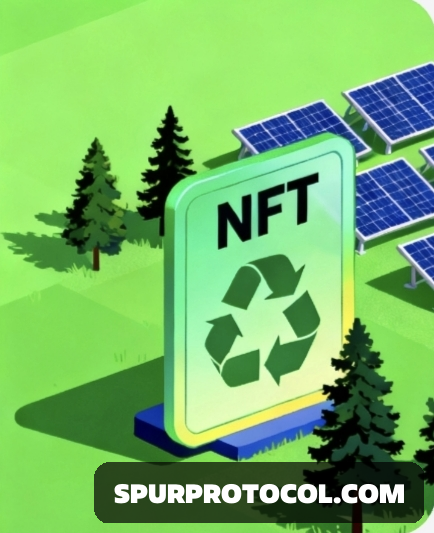
Non-Fungible Tokens (NFTs) represent a programmable model of digital ownership built on blockchain infrastructure. While they have enabled new economic models for creators and digital assets, NFTs have also been scrutinized for their environmental impact. This criticism is largely rooted in the energy consumption patterns of the underlying blockchain technologies rather than the NFT standard itself.
Go Back
🕒 8:36 PM
📅 Feb 07, 2026
✍️ By Goko7
Technical Sources of Environmental Impact
NFTs are not inherently energy-intensive; their footprint depends on the consensus mechanism of the blockchain on which they are issued and traded. Early NFT adoption occurred primarily on proof-of-work (PoW) blockchains, where transaction validation relies on competitive computational processes.
In PoW systems, network security is achieved
through mining, which requires continuous high-performance computation. Each NFT-related operation
—minting, transferring, bidding, or settlement
—adds transactional load to the network.
During periods of congestion, this resulted in increased energy usage per transaction and, by extension, higher associated carbon emissions.
It is important to note that the environmental cost is systemic, not transactional in isolation. NFTs function as smart contract interactions and inherit the energy profile of the network as a whole.
Transition to Energy-Efficient Consensus Models
The most significant reduction in environmental impact has come from the adoption of proof-of-stake (PoS) and other low-energy consensus mechanisms. In PoS systems, validators are selected based on economic stake rather than computational output, eliminating the need for energy-intensive mining.
This transition reduces energy consumption by several orders of magnitude while maintaining decentralization and security properties suitable for NFT ecosystems. Many modern NFT platforms now operate exclusively on PoS-based blockchains or layer-2 networks that further optimize transaction efficiency through batching and off-chain computation.
Infrastructure-Level Sustainability Measures
Beyond consensus mechanisms, sustainability efforts in the NFT ecosystem include:
Layer-2 scaling solutions that reduce on-chain transaction frequency
Blockchain networks optimized for low energy consumption by design
Use of renewable energy sources by validator and node operators
Carbon accounting and offset programs at the platform level
From a technical standpoint, these measures address the root causes of energy usage rather than applying superficial mitigation strategies.
Long-Term Outlook
NFTs should be evaluated as part of a broader blockchain infrastructure stack. As that stack matures
—through improved consensus algorithms, scalability solutions, and energy-aware network design
—the environmental impact of NFTs continues to decline.
The question is no longer whether NFTs can operate sustainably, but how quickly best practices become standardized across the ecosystem. With continued technical optimization and transparent environmental metrics, NFTs can function as a viable digital ownership layer with a controlled and measurable environmental footprint.