The Impact On Traditional Job Markets And New Skill Demands
In 2026, the global labor market is undergoing a significant transformation driven by artificial intelligence (AI), the green transition, and the expansion of the gig economy.
Go Back
🕒 9:25 PM
📅 Jan 26, 2026
✍️ By chyneyz
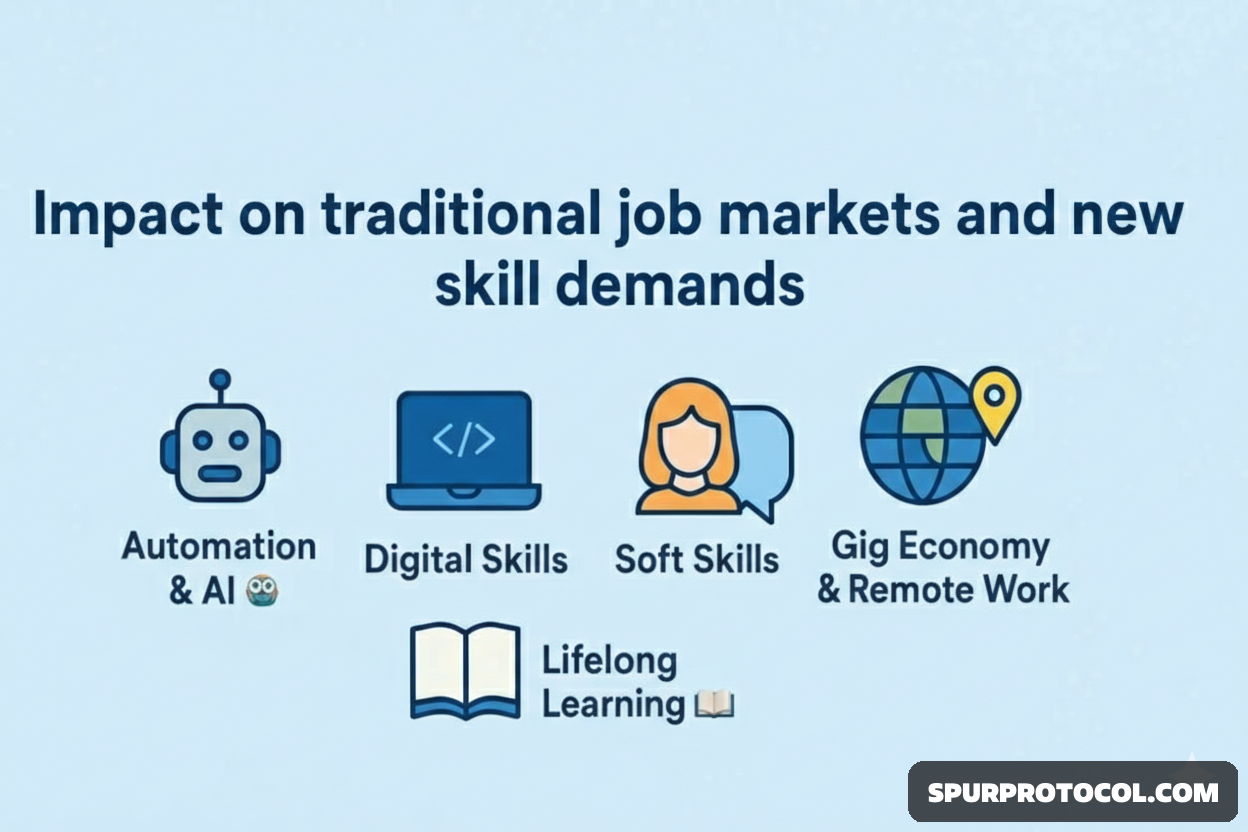
Impact on Traditional Job MarketsThe traditional employment model—characterized by long-term contracts and fixed roles—is being disrupted by automation and a shift toward skills-based hiring.
Job Displacement: By 2030, an estimated 92 million jobs are expected to be displaced globally. Roles most at risk involve routine or manual tasks that can be automated, such as data entry, administrative assistants, bank tellers, and cashiers.
New Job Creation: Simultaneously, approximately 170 million new positions are projected to emerge by 2030. Growth is concentrated in tech-driven fields (AI prompt engineering, data science) and traditional sectors boosted by the green transition, such as farmwork (35 million new jobs) and building construction.
Shift to Gig Work: There is a notable rise in short-term, project-based assignments. While this offers high flexibility, it has introduced challenges like income volatility and a lack of traditional benefits (health insurance, retirement plans).
Skill-Based Models: Organizations are moving away from rigid job descriptions toward a "skills-based" approach, where work is broken down into specific tasks that can be assigned to internal or external talent based on demonstrated competencies.
New Skill Demands
The rapid pace of technological change means that roughly 39% of current skill sets are expected to become obsolete by 2030.
Digital & Technical Literacy: Beyond specialized AI and coding skills, there is a universal demand for digital fluency to navigate increasingly tech-driven work environments.
Human-Centric Soft Skills: As machines handle routine data processing, human workers are being redirected toward high-value "non-routine" tasks.
Key in-demand skills include:
Cognitive Abilities: Critical thinking, complex problem-solving, and creative innovation.
Interpersonal Skills: Collaboration, multicultural communication, and leadership.
Adaptability: The ability to learn continuously and navigate vocational identity shifts as roles evolve.
Lifelong Learning: Continuous retraining is now a necessity rather than an option. Governments and businesses are increasingly promoting initiatives like Singapore's SkillsFuture to support workforce upskilling.