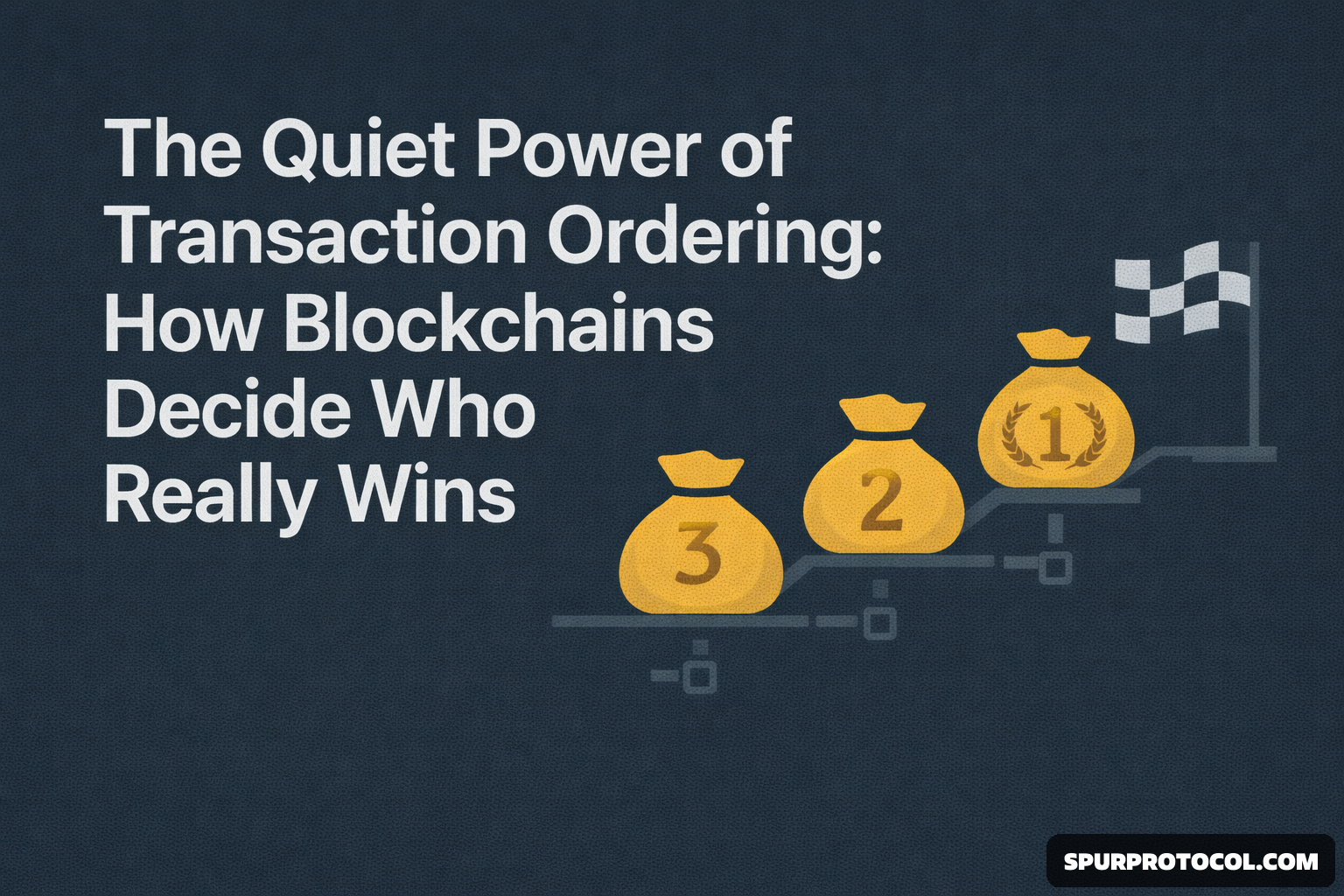
The Quiet Power Of Transaction Ordering: How Blockchains Decide Who Really Wins
Most users think speed decides outcomes on-chain. In reality, transaction ordering decides who profits, who loses, and who never gets noticed
Go Back
🕒 2:02 PM
📅 Dec 16, 2025
✍️ By Uday3327
When you send a transaction on a blockchain, you probably think the story ends with confirmation. It doesn’t. The real battle happens before your transaction is even included in a block.
Here’s the thing. Blockchains don’t just confirm transactions. They choose an order. And that order quietly reshapes markets, liquidations, arbitrage, and even user trust.
Why Ordering Matters More Than Speed
Most blockchains receive thousands of transactions at the same time. They cannot process everything instantly, so they queue transactions and decide which one goes first.
That single decision changes outcomes:
A trade executed first gets a better price
A liquidation triggered earlier wipes out competitors
An arbitrage captured first leaves nothing for others
Same transaction. Same block. Different order. Completely different result.
MEV: The Hidden Incentive Layer
This is where Maximal Extractable Value (MEV) enters the picture.
MEV is the profit extracted by reordering, inserting, or excluding transactions inside a block. Validators and sophisticated bots scan the mempool, detect profitable opportunities, and rearrange transactions to capture value.
What this really means is simple.
The blockchain is neutral at the protocol level, but economic incentives bend behavior at the execution level.
Why Regular Users Feel the Impact
You don’t need to run a bot to feel MEV.
You experience it when:
Your trade executes at a worse price than expected
Your transaction fails after paying gas
A liquidation happens milliseconds before your hedge
From the user’s perspective, it feels random. It’s not. It’s competition for position.
Are Blockchains Fixing This?
Different chains are experimenting with solutions:
Private mempools to hide transactions before inclusion
Fair ordering mechanisms that reduce manipulation
Proposer-builder separation (PBS) to limit validator power
None of these fully remove MEV. They redistribute it.
That’s the uncomfortable truth. MEV isn’t a bug you can delete. It’s a byproduct of open, competitive systems.
The Bigger Picture
Transaction ordering reveals something deeper about blockchains.
They are not just ledgers.
They are markets for priority.
Every block is an auction. Every transaction is a bid. And every validator is a referee with incentives.
Understanding this doesn’t make crypto weaker. It makes it more honest.
Because once you see how ordering works, you stop assuming fairness is automatic. You start demanding better design.
And that’s how blockchains actually evolve.