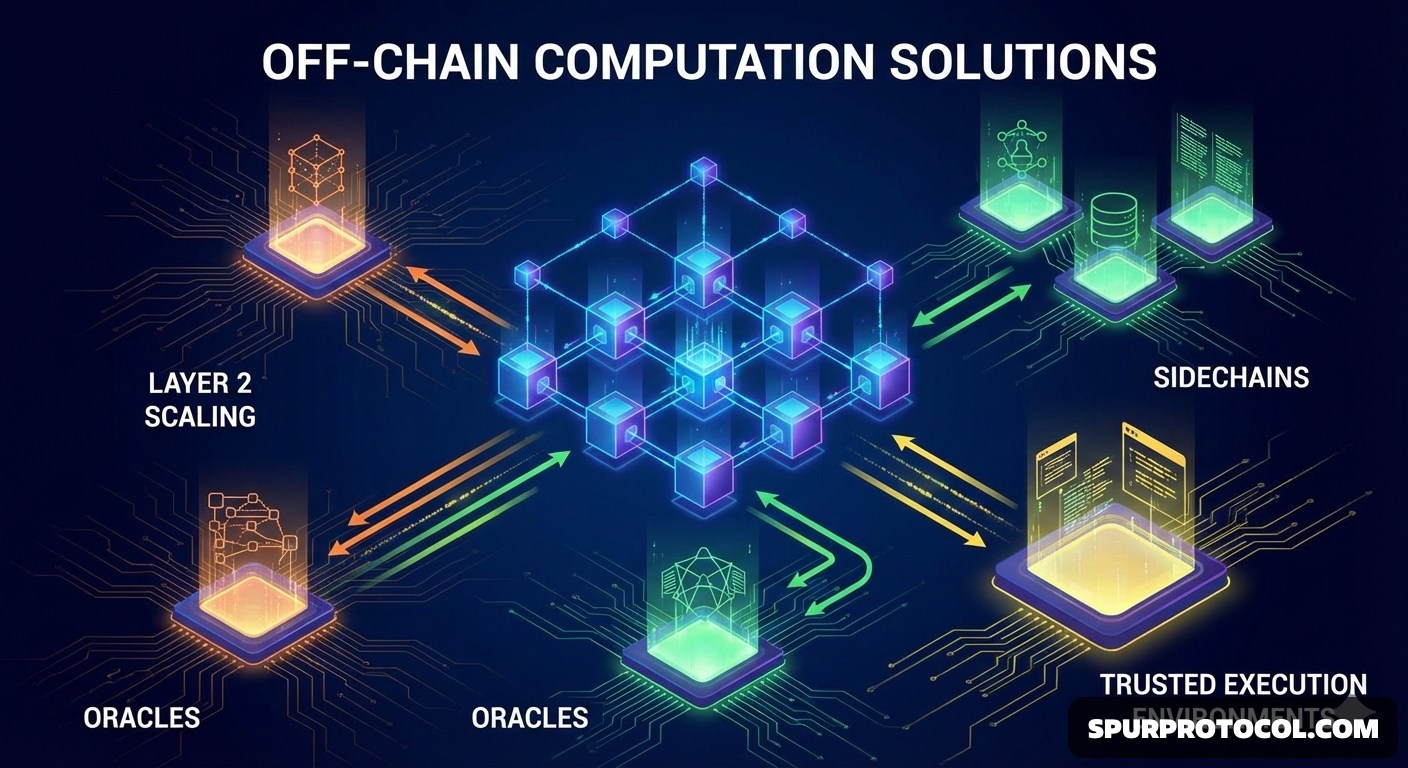
Blockchains are designed for security and immutability, but this often comes at the cost of speed and efficiency (scalability issues). Off-chain solutions address these limitations by:
Improving Scalability and Speed: Transactions and computations are processed faster off-chain since they don't require immediate network-wide consensus and validation.
Reducing Costs:
By avoiding the high gas fees associated with on-chain execution, off-chain solutions make microtransactions and complex operations economically feasible.
Enhancing Privacy:
Sensitive data or transaction details can be kept off a public ledger, only posting a summary or cryptographic proof on the main chain, which ensures confidentiality.
Enabling Advanced Features:
Off-chain computation allows for more advanced functionalities, such as provably fair randomness (used in gaming and NFTs) and smart contract automation, which would be too resource-intensive to run entirely on-chain.
Key Solutions and Technologies
Various architectural approaches and technologies are used to implement off-chain computation solutions:
Layer 2 Solutions (Rollups and Sidechains): These are secondary frameworks built on top of a primary blockchain.
Rollups (Optimistic and ZK-Rollups):
These protocols execute transactions off-chain, bundle them into a single transaction (a "rollup"), and submit a concise, verifiable summary or cryptographic proof to the main chain, significantly reducing the on-chain load.
Payment/State Channels (e.g., Bitcoin Lightning Network, Ethereum Raiden Network):
These allow two parties to conduct numerous transactions off-chain in a private channel, with only the channel opening and final settlement transactions recorded on the main chain.
Decentralized Oracle Networks (DONs): Oracles function as bridges between blockchains and the outside world. DONs, like Chainlink, perform trust-minimized off-chain computations (e.g., data aggregation, statistical analysis, automation, verifiable randomness generation) and relay the results back to smart contracts with cryptographic proofs of authenticity.
Trusted Execution Environments (TEEs): TEEs are secure, isolated areas within a processor's hardware that can run code and process data in a way that is protected from external tampering, even by the machine's operator. This enables verifiable confidential off-chain computation.
Off-Chain Storage: Instead of storing large files directly on the expensive blockchain, data is kept on external systems (like IPFS or cloud storage), and only a unique cryptographic hash (a "fingerprint") of the data is stored on the chain to ensure its integrity and authenticity.